PORZELLAN, POLITIK UND VIEL POESIE – PORCELAIN, POLITICS, AND LOTS OF POETRY

Interview mit Sharon Berkal, Haus Glanz, April 2023
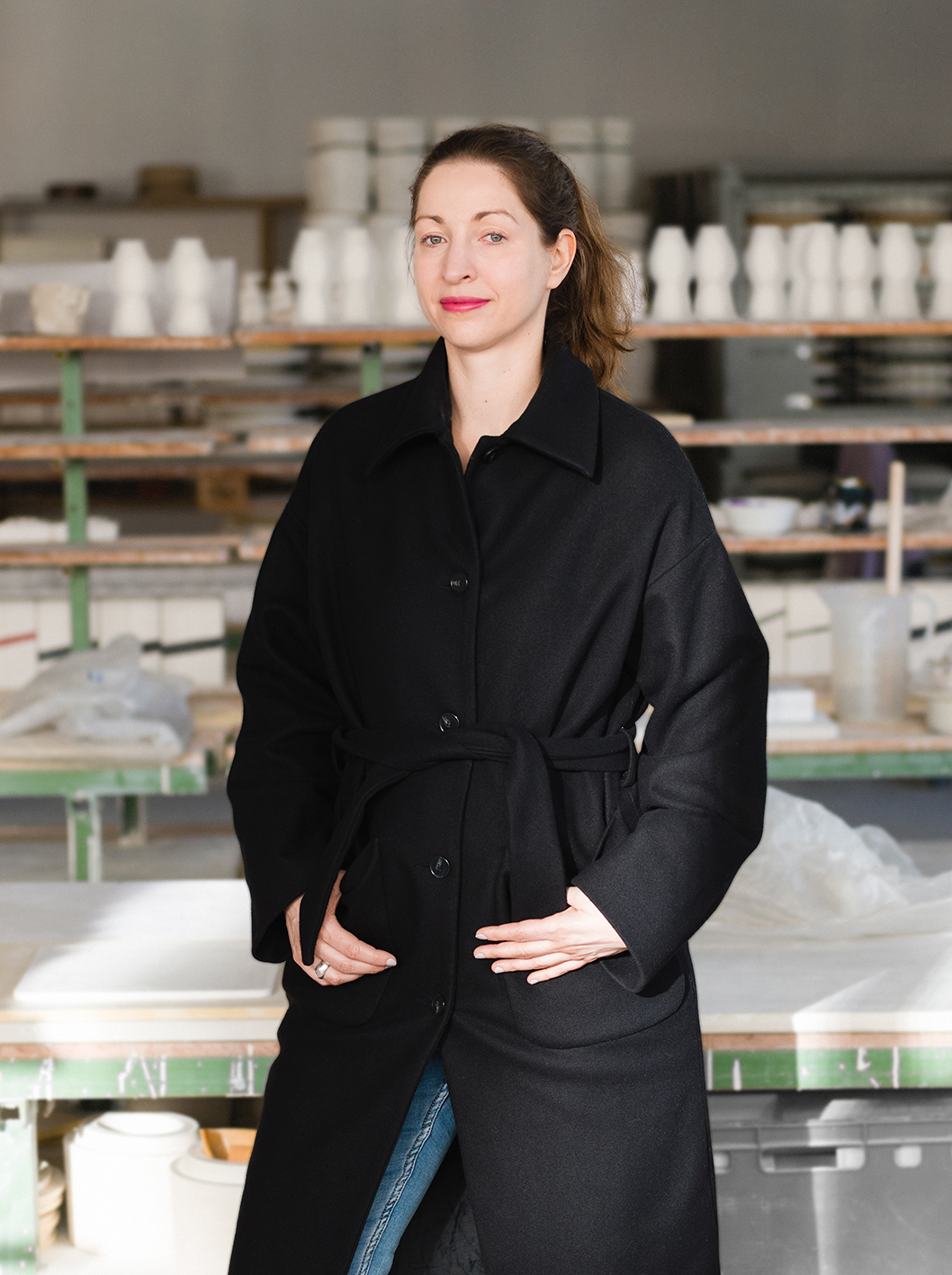
 

RONA KOBEL ist bildende Künstlerin und lebt und arbeitet in Berlin. Ihre glänzenden, mit politischer Schlagkraft versehenen Objekte stellt sie bereits seit vielen Jahren aus KPM-Porzellan her. Ein gemeinsames Projekt ist nun die natürliche und perfekte Schlussfolgerung.


SHARON BERKAL: Die Geschichte der HALLE-Vase ist auch die Geschichte Deutschlands. Sie ist quasi ein Politikum. Wie hast Du versucht, diesem Thema künstlerisch Herr zu werden?

RONA KOBEL: Ich habe mich in zwei Schritten dem Thema genähert. Zum einen direkt über Marguerite Friedländer: Ihr Name wurde in den Produktionsblättern der KPM während des Nationalsozialismus weggestrichen. Es blieb nur noch ein schwarzer Balken übrig. Ich habe ihre Signatur wieder zurück auf die Vasen geholt! Zum anderen beziehe ich mich mit den Arbeiten auf auf die politische Situation von heute. In Form von den Worten, die ich in die Vasen eingearbeitet habe. Da haben wir zum Beispiel das Relief „Freedoom“, das thematisieren soll, dass die Freiheit auch heute immer noch ein sehr zerbrechliches Gut ist. Ich finde, uns ist viel zu wenig bewusst, dass es so viele Länder gibt, in denen die Menschen überhaupt nicht so frei sind, wie wir. Und dass auch hier die Freiheit eines unserer höchsten Güter ist und wir sie immer aus Neue bewahren und schützen müssen. Bei der großen Vase betone ich mit dem Relief „CouRAGE“ die Rage, die Wut. Es soll zeigen, dass, wenn man etwas verändern möchte, es auch eine gewisse Wut als Antrieb, als positive Kraft braucht. Das war damals und heute so. Das ist Geschichte und Gegenwart.

SB: Was war Deine gestalterische Herausforderung an diesem Projekt?

RK: Ich bin Bildhauerin und wusste sofort, dass ich die Form dreidimensional verändern möchte. Ich hatte mir am Anfang ein Modell der Vase ausgeliehen und erst einmal oberflächlich mit verschiedenen Typografien experimentiert. Es war mir sehr schnell klar, dass ich mich mit dem Thema „Freiheit“ beschäftigen möchte. Es kam mir nicht nur mit Bezug zu Marguerite Friedlaender in den Sinn, sondern auch weil das freiheitliche Denken des Bauhauses mit dem Nationalsozialismus sein Ende fand. Als dann jede Vase meiner bildnerischen Vorstellung entsprach, haben wir angefangen, komplett neue Formen zu bauen, so dass die Worte eben nicht nur ein aufgesetztes Dekor werden, sondern ein Teil der Vase sind. Wenn Sie jetzt in die Vase greifen, können Sie das Relief der Schrift als Negativ spüren und natürlich auch sehen.

SB: Warum arbeitest Du so gerne mit Porzellan?

RK: An Porzellan mag ich am meisten, dass es edel aussieht und so unschuldig weiß glänzt. Ich finde es total spannend, mit diesem schönen Material andere, eher unschöne und schreckliche Inhalte zu kommunizieren. Man wird erst von der Schönheit des Objektes angezogen, beginnt es zu betrachten, während sich seine Botschaft und Geschichte voll entfaltet und zum Vorschein kommt. Man schluckt die schwere Kost, ohne es zu merken. Diese Irritation, die dabei immer hervorgerufen wird, finde ich total spannend.
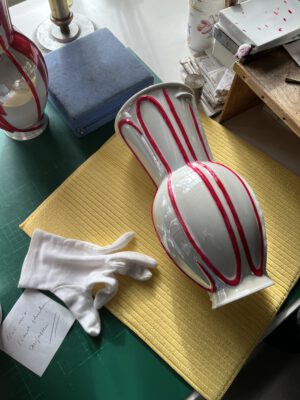
 

1931 entwarf MARGUERITE FRIEDLAENDER die HALLE-Vase, in Proportionen, Linienführung und schlichtem Schwung eine Ikone der Bauhaus-Tradition und heute ein internationales Aushängeschild für Design made in Germany. Doch die gebührende Anerkennung sollte der jüdischen Designerin mit dem aufkommenden Nationalsozialismus zunächst verwehrt werden: FRIEDLAENDER wurde als Gestalterin des Produktes aus den Unterlagen gestrichen, ihr Entwurf vorläufig namenlos und erst viele Jahre später wieder mit großem Stolz unter ihrem Namen durch die Königliche Porzellan-Manufaktur Berlin weiterverkauft.

Über 90 Jahre später schuf nun RONA KOBEL daraus Objekte mit politischer Schlagkraft. Mit pudrigen Pastelltönen, neobarocken Schleifen oder metallischer Lüsterfarbe regt die Berliner Künstlerin an, die Welt zu hinterfragen. Ihr subtilster Clou des Remakes findet sich aber auf den Böden beziehungsweise im Hals der limitierten Kunstwerke und verhilft ihrer Schöpferin FRIEDLAENDER zu einem Comeback.

Interview with Sharon Berkal, Haus Glanz, April 2023

RONA KOBEL is a visual artist who lives and works in Berlin. For many years, she has been creating her shiny, politically powerful objects from KPM porcelain. A joint project is now the natural and perfect conclusion.

SHARON BERKAL: The history of the HALLE vase is also the history of Germany. It is, in a sense, a political issue. How did you attempt to address this topic artistically?

RONA KOBEL: I approached the subject in two stages. Firstly, directly via Marguerite Friedländer: her name was removed from the KPM production sheets during the Nazi era. All that remained was a black bar. I put her signature back on the vases! Secondly, my work refers to the political situation today. In the form of the words I have incorporated into the vases. For example, we have the relief “Freedoom,” which is intended to address the fact that freedom is still a very fragile commodity today. I think we are far too unaware that there are so many countries where people are not nearly as free as we are. And that freedom is one of our most precious commodities here too, and we must constantly preserve and protect it. On the large vase, I use the relief “CouRAGE” to emphasize rage, anger. It is meant to show that if you want to change something, you also need a certain amount of anger as motivation, as a positive force. That was true then and it is true today. That is history and the present.

SB: What was your creative challenge in this project?

RK: I am a sculptor and knew immediately that I wanted to change the form three-dimensionally. At the beginning, I borrowed a model of the vase and experimented superficially with different typographies. It quickly became clear to me that I wanted to deal with the theme of “freedom.” This came to mind not only in relation to Marguerite Friedlaender, but also because the liberal thinking of the Bauhaus came to an end with the rise of National Socialism. Once each vase corresponded to my artistic vision, we began to build completely new forms so that the words would not just be an added decoration, but part of the vase itself. When you reach into the vase now, you can feel the relief of the lettering as a negative and, of course, see it too.

SB: Why do you enjoy working with porcelain so much?

RK: What I like most about porcelain is that it looks elegant and has such an innocent white shine. I find it really exciting to use this beautiful material to communicate other, rather unattractive and terrible content. You are first attracted by the beauty of the object, you begin to look at it, while its message and story unfold and come to light. You swallow the heavy stuff without even noticing. I find the irritation that this always causes really exciting.

In 1931, MARGUERITE FRIEDLAENDER designed the HALLE vase, which, with its proportions, lines, and simple curves, became an icon of the Bauhaus tradition and is now an international symbol of design made in Germany. However, the Jewish designer was initially denied the recognition she deserved with the rise of National Socialism: FRIEDLAENDER was removed from the records as the designer of the product, her design was temporarily nameless, and it was only many years later that it was proudly sold again under her name by the Royal Porcelain Manufactory Berlin.

More than 90 years later, RONA KOBEL has now created objects with political impact from it. With powdery pastel shades, neo-baroque bows, and metallic luster paint, the Berlin artist encourages us to question the world. However, the most subtle highlight of the remake can be found on the bases or in the necks of the limited-edition artworks, helping their creator, FRIEDLAENDER, make a comeback.

Porträt: Trevor Good