von LUDWIG SEYFARTH, zur Ausstellung Dinner for Sinner im Drawing Room Hamburg, 26.4. – 21.6.2018
Die Europa auf dem Stier ist ein beliebtes Motiv klassischer Porzellankunst, von dem die Berliner Künstlerin Rona Kobel zwei aktuelle Varianten ersonnen hat. Die erste folgt stilistisch und in der Akkuratesse der Ausführung noch den klassischen Vorbildern, die zweite Version hingegen entfernt sich radikal von gediegenem Hausschmuck. Europa ist vom Stier gestiegen und hat sich ein Messer in die Brust gerammt. Brexit, EU- feindliche Politik in vielen Ländern: Ist Europa am Ende?
Die Frage nach der „Stabilität und Wehrhaftigkeit von Demokratie und Freiheit“ ist das dezidiert formulierte Anliegen Rona Kobels, die sich dafür jedoch anderer Mittel bedient als der üblichen Medien, die man bei politischer Kunst gemeinhin erwartet.
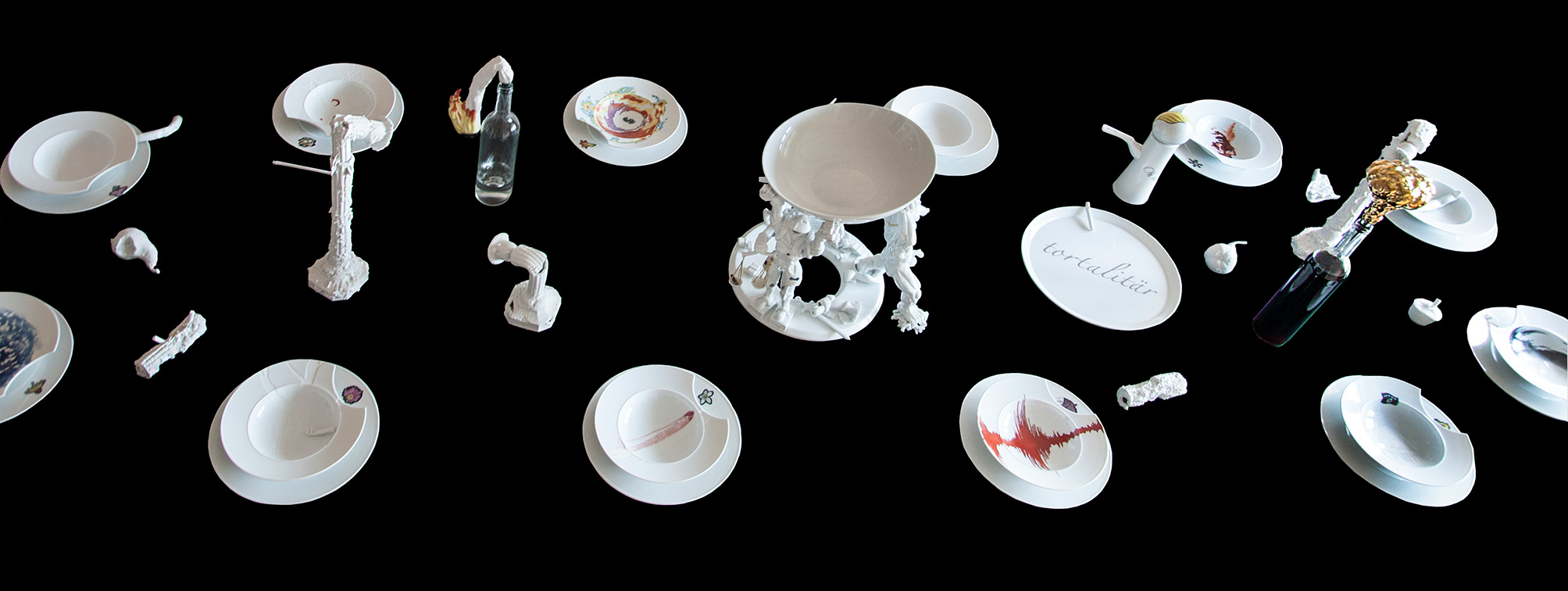
Die „Europa“ ist nur eine von zahlreichen Porzellanfiguren und –accessoires, welche die Künstlerin als „politisches Tafelgedeck“ entworfen und in der Königlichen Porzellanmanufaktur in Berlin hergestellt hat: Speise- und Suppenteller, Kannen, diverse kleinere Accessoires und einen großen Tafelaufsatz mit großer Terrine. Letztere ist allerdings in eine prekäre Schieflage geraten, weil die drei Figuren, die sie tragen, ihrer Aufgabe nicht gewachsen scheinen. Es sind collagehafte Monstren, die den Kapitalismus, die Freiheit und die Rechtsstaatlichkeit verkörpern sollen. Aber ein gieriger, allesfressender Muskelprotz, eine kokett mit sich selbst beschäftigte, leicht be- kleidete Dame und eine klapperige, leere Ritterrüstung sind offenbar nicht in der Lage, die gesellschaftliche Stabilität aufrecht zu erhalten.
Vorbild für diese karikierten Darstellungen sind Allegorien, die abstrakte Begriffe anschaulich verkörpern sollen. Diese haben im Barock und Rokoko nicht nur die Schlossgärten bevölkert, sondern auch als Porzellanfiguren zur Dekoration der Innenräume und Speisetafeln beigetragen. Die Ikonographie von Porzellangeschirr und – figuren diente der Repräsentation und Stützung eines feudalen Systems, von dessen Flair auch bürgerliche Gesellschaften noch zu profitieren suchten. Doch das vererbte edle Porzellanservice wurde in der Moderne zum Synonym des Geschmacks der Großeltern, das als überflüssiger „Nippes“ bestenfalls noch für den Flohmarkt taugt.
Auch die größten Meisterwerke der Porzellankunst sind in der Regel immer noch in Kunstgewerbe- und nicht in Kunstmuseen zu sehen. Und wenn moderne oder zeitgenössische Künstler wie Picasso sich der Keramik zuwandten, dann wird die rauhe Oberfläche des Tons oft der glasierten Oberfläche vorgezogen. Kritische politische Aussagen erwartet man auch bei avancierter Keramikkunst kaum. Und wenn Künstler dezidiert zu Tisch bitten, wie es Rona Kobel tut, geschieht das eher nicht in traditionellem Tafelgedeck, sondern in mobilem, selbstgezimmertem Inventar, etwa bei Rirkrit Tiravanija, der seit den 1990er Jahren thailändisches Essen in Ausstellungsräumen serviert hat.
Auch solche „Dienstleistungskunst“ wird von Rona Kobel subversiv unterwandert. Denn die Suppe könnte einem übel aufstoßen, wenn man sie ausgelöffelt hat und in die Tiefe des Tellers blicken kann. Die Motive, die die Böden der Suppenteller „zieren“, entstammen Medienbildern von Lynchmorden, die in den letzten Jahren in Afghanistan, in Indien oder in Südafrika verübt wurden, oder von Naturkatastrophen (Hurrikan, Tsunami, Dürre, Erdbeben). Eine dritte Motivgruppe veranschaulicht politische Allmachtsphantasien wie die Eroberung Roms durch den IS oder Putins Satan II-Rakete als Demonstration militärischen Weltmachtstrebens. Lieblicher scheinen die Verzierungen der Speiseteller. Die Blumen auf ihren Rändern zeichnet jedoch ein nicht direkt sichtbares, unangenehmes Moment aus. Ihnen wurden Namen gegeben, die deutliche rassistische Konnotationen enthalten.
Die Weinflaschen können mit Stopfen verschlossen werden, die dem Atompilz über Nagasaki und einem explodierenden Molotow-Cocktail nachgebildet sind – und die entsprechenden Spitznamen „Fat Man“ und „Molly“ tragen: So knallen die Korken imaginär immer weiter. Und die Kerzenständer sehen so aus, als sein sie erschlafft und lassen den Kopf hängen, wobei auch Assoziationen an mögliche Zustände eines anderen männlichen Körperteils nicht ausbleiben. „Stubenrein“ ist Rona Kobels Tafelgedeck gewiss nicht, aber sexuelle Anzüglichkeiten gehörten schon bei den Porzellanfiguren des Rokoko, anders als politische Themen, durchaus zum Standardrepertoire.
by LUDWIG SEYFARTH, to the exhibition „Dinner for Sinner“, Drawing Room Hamburg, 26.4. – 21.6.2018
Europa riding the bull is a popular motif in classical porcelain art, of which Berlin artist Rona Kobel has devised two contemporary variations. The first remains true stylistically as well as in its minutiae to the classical models, whereas the second version departs radically from sedate home decoration. Europa has climbed down from the bull and is ramming a knife into her breast. With Brexit and Eurosceptic politics in many countries: is Europa at an end?
Rona Kobel’s resolutely formulated concern is the question of the „stability and defensibility of democracy and freedom“, for which, however, she makes use of different media than those commonly expected in political art.
The „Europa“ is just one of numerous porcelain figures and accessories the artist has designed as „political tableware“, and then produced in Berlin’s „Königliche Porzellan-Manufaktur“: dinner plates and soup plates, jugs, diverse smaller accessories, and a grand centrepiece with a large tureen. The latter, however, is stranded at a precarious angle, because the three figures carrying it don’t seem to be up to their task. These are collage-like monsters, intended to represent capitalism, freedom, and the rule of law. However, a greedy, all-consuming musclehead, a coquettish, self-absorbed, and lightly-dressed lady, and a battered, empty suit of armour are clearly not in a position to maintain social stability.
The role models for these caricatures are allegories, intended to vividly embody the abstract concepts. During the Baroque and Rococo such allegories populated not only castle gardens, but as porcelain figures they also added to the decoration of interior rooms and dining tables. The iconography of porcelain tableware and figures served to represent and underpin a feudal system, and civil society also sought to benefit from its flair. Yet in the modern era the handed-down porcelain service became synonymous with one’s grandparents‘ tastes, and as superfluous ‚bric-a-brac‘ was suitable at best for the flea market.
Even the greatest masterpieces of porcelain art are generally only exhibited in arts and crafts museums, and not in fine art museums. When modern or contemporary artists such as Picasso turn to ceramics, the raw surface of the clay is often preferred to the glazed surface. One also hardly expects critical political statements in cutting-edge ceramic art. Furthermore, when artists graciously invite you to the table, as Rona Kobel does, then that generally involves not traditional tableware, but mobile, self-constructed trappings, such as in the work of Rirkrit Tiravanija, who has served Thai food in exhibition rooms since the 1990s.
Rona Kobel also subversively infiltrates this type of „service art“. For the soup, once one has ladled it out and can gaze into the depths of the bowl, could leave a nasty taste in your mouth. The motifs which „adorn“ the bottom of the soup plates are derived from media images of lynching carried out in the last few years in Afghanistan, India, or South Africa, and of natural catastrophes (hurricanes, tsunamis, droughts, and earthquakes). A third group of motifs illustrate fantasies of political omnipotence, such as the conquest of Rome by ISIS, or Putin’s Satan II rockets as demonstrating ambitions of military world domination. The decorations on the dinner plates appear more pleasing. The flowers on their borders, however, feature an unpleasant aspect that is not directly visible. They have been given names which hold clear racist connotations.
The wine bottles can be plugged using stoppers modelled after the atomic mushroom cloud over Nagasaki, or an exploding Molotov cocktail – and bearing the corresponding nicknames „Fat Man“ and „Molly“. Thus, the corks can continue to pop on and on in one’s imagination. As well, the candle holders look as though they have fallen asleep, letting their heads droop, whereby associations with possible states of another male body part also cannot go unnoticed. Rona Kobel’s tableware is definitely not ‚house broken‘, yet unlike political themes, sexual ribaldry certainly was part of the standard repertoire of the Rococo.